ISLAMABAD: The estimated cost of Pakistan’s under-construction Mohmand Dam has surged to Rs666 billion, marking a 115 per cent increase from the original Rs310 billion approved in 2018, largely due to rupee depreciation, design changes, flood damage and security-related delays.
Thank you for reading this post, don't forget to subscribe!The revised project cost was presented to the Central Development Working Party (CDWP) this week. However, the forum deferred consideration of the proposal due to a shortage of time, according to federal government officials. The project’s revised cost will require further scrutiny before consideration by the Executive Committee of the National Economic Council (ECNEC), the final approval forum for major development projects.
The Water and Power Development Authority (WAPDA), which is executing the project, has estimated the cost increase at Rs356 billion. The project was originally scheduled for completion by September 2025, but its timeline has been affected by several challenges, including foreign exchange fluctuations, design modifications, the devastating 2022 floods and security issues.
According to Planning Commission officials, WAPDA attributed approximately 51 per cent of the overall cost escalation to changes in the dollar-rupee exchange rate. The project includes both local and foreign currency components, and rupee depreciation has significantly increased the domestic currency equivalent of foreign expenditure.
The Planning Commission has sought details of dollar-denominated contractual payments and clarification on the extent to which exchange-rate variations can legitimately be reflected in the revised project cost. Officials emphasised that foreign currency components must be assessed against actual contractual obligations and applicable exchange-rate provisions rather than simply being converted at current market rates.
The cost revision comes amid renewed scrutiny of Pakistan’s exchange-rate policy. The World Bank recently highlighted a gap between the market exchange rate and the official daily rate, while the State Bank of Pakistan has also been assessing currency valuation through its Real Effective Exchange Rate (REER) framework.
According to project documents, physical progress had reached approximately 57 per cent by September 2026, with Rs275 billion already spent.
ECNEC approved the Mohmand Dam project in April 2018 at an estimated cost of Rs310 billion, including a rupee component of Rs71.5 billion. Under the latest proposal, the dam component has increased to Rs267 billion, up Rs153 billion, or 134 per cent, from the original estimate. The power generation component has risen to Rs399 billion, an increase of Rs204 billion, or 105 per cent.
A joint venture of China Gezhouba Group Company Limited (CGGC) and Pakistan’s Descon Engineering Limited is constructing the dam.
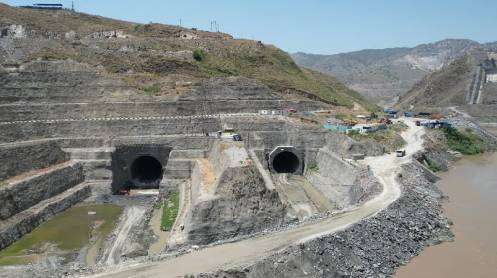
The project suffered a major setback during the 2022 floods, when heavy flows in the Swat River damaged diversion tunnels and halted construction for a considerable period, according to the project management’s explanation submitted to the Planning Commission.
The Planning Commission has described the project as an example of the delays and implementation challenges affecting major WAPDA-led schemes. It has recommended third-party validation of financial and physical resource utilisation, the scope of work, variation orders, escalation costs, the project gestation period and financial closure.
The commission has also called for an updated financial plan detailing the federal government’s contribution through the Public Sector Development Programme (PSDP), any provincial funding share and loans from foreign lenders.
Upon completion, Mohmand Dam is expected to add approximately 1.29 million acre-feet to Pakistan’s water storage capacity, generate around 2.9 billion units of electricity annually and supply 300 million gallons of drinking water to Peshawar each year.
The project is considered important for addressing Pakistan’s water storage deficit, strengthening energy security and improving resilience against climate-induced floods. However, the substantial cost escalation and construction delays have raised questions about project management, financial oversight and the long-term burden on public development spending.
Story by Shahbaz Rana